
Class 8 Grammar Worksheet on Text Evidence Skills

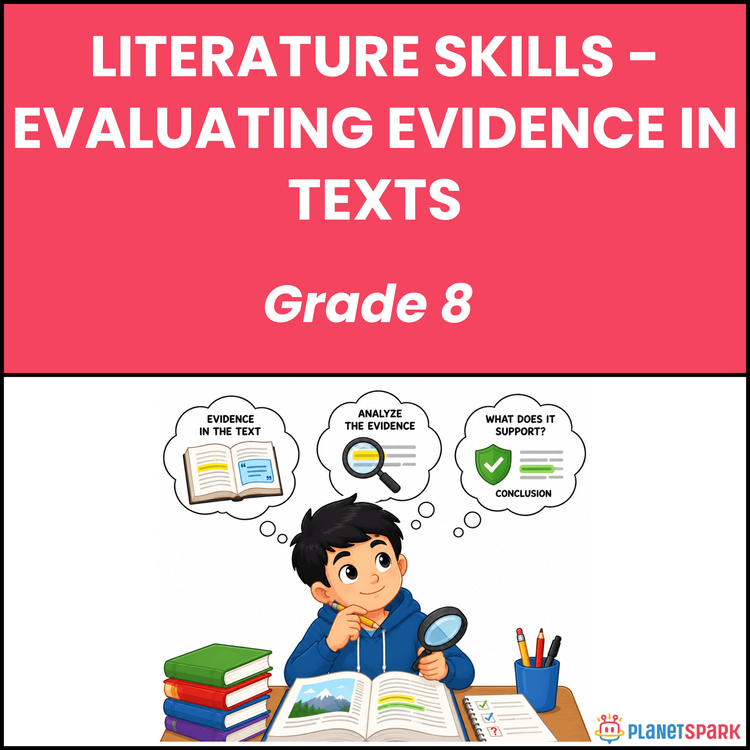
Class 8 Grammar Worksheet on Text Evidence Skills
Proof or Opinion? Evaluating Evidence in Texts for Grade 8
This Grade 8 worksheet on Literature Skills – Evaluating Evidence in Texts helps students strengthen their reading comprehension, analytical thinking, and grammar-based interpretation skills through engaging evidence evaluation activities. Learners explore how facts, statistics, opinions, surveys, and research reports support or weaken claims in informational texts.
Why Evaluating Evidence Matters in Grammar?
Evaluating evidence helps students become thoughtful readers and stronger communicators. For Grade 8 learners, this topic is important because:
1. It teaches students how to distinguish facts from opinions.
2. It improves critical reading and reasoning skills.
3. It helps learners identify reliable and unreliable information.
4. It supports analytical writing and evidence-based responses.
5. It builds awareness of how authors support arguments in texts.
What’s Inside This Worksheet?
This worksheet includes five grammar-rich and comprehension-based activities that help students evaluate evidence in a structured and engaging way:
Exercise 1 – Multiple Choice Questions
Students read carefully and select the strongest or weakest evidence from different examples related to pollution reports and research findings.
Exercise 2 – Match the Following
Learners match evidence types such as “Scientific survey” and “General rumor” with descriptions like “Reliable source” or “Unproven claim” to understand evidence quality.
Exercise 3 – True or False
Students decide whether statements about evidence, pollution data, and research reliability are true or false based on the reading passage.
Exercise 4 – Sort Strong and Weak Evidence
Students sort examples like “Scientific data” and “Random rumor” into strong or weak evidence categories to build analytical classification skills.
Exercise 5 – Short Answer Questions
Learners answer text-based questions explaining why scientific data is stronger than opinions and how readers can judge evidence reliability.
✅ Answer Key (For Parents & Educators)
Exercise 1 – Multiple Choice Questions
1. b) Data from air quality tests
2. c) A personal opinion
3. a) Factory smoke measured daily
4. c) A rumor from neighbors
5. b) It sounds emotional
6. a) They support arguments
7. b) Many rivers look dirty
8. c) It changes often
9. a) To judge reliability
10. c) Someone heard pollution increased
Exercise 2 – Match the Following
1. Clear statistics – Fact-based detail
2. Laboratory report – Checked information
3. Vague opinion – Weak evidence
4. Unclear statement – Not easy to verify
5. Personal feeling – Emotional response
6. Verified research – Reliable source
7. Scientific survey – Strong evidence
8. Pollution chart – Visual data
9. General rumor – Unproven claim
10. Test results – Clear support
Exercise 3 – True or False
1. True
2. False
3. True
4. False
5. True
6. True
7. True
8. False
9. False
10. True
Exercise 4 – Sort Strong and Weak Evidence
Strong Evidence:
- Air quality report
- Scientific data
- Lab-tested sample
- Exact pollution numbers
- Clear pollution graph
- Verified survey
Weak Evidence:
- Random rumor
- People feel unsafe
- Someone guessed levels
- Personal opinion
Exercise 5 – Short Answer Questions
1. Scientific data is stronger than opinions because it is tested, researched, and supported by facts or numbers.
2. Readers can decide if evidence is reliable by checking whether it comes from trusted sources, includes facts or statistics, and can be verified.
3. The weak evidence in the article includes statements like “many people believe pollution is getting worse” because no clear source or proof is given.
Help your child improve analytical reading and evidence evaluation skills with expert-designed Grade 8 English grammar worksheets from PlanetSpark.
🔖Book a free trial!
Frequently Asked Questions
It is using proof from the text to support answers.
By quoting or referring to relevant lines from the passage.
They strengthen answer accuracy and justification.